Saturday, January 28, 2012

Anglican Human Rights

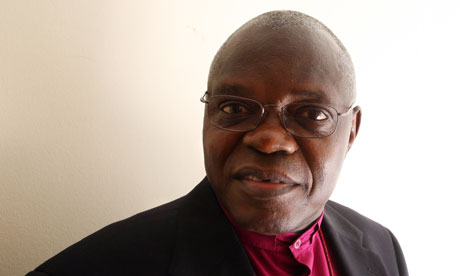
(His Grace Archbishop Dr. John Sentamu, Archbishop of York)

Nothing divides the Anglican Church like homosexuality. This is hardly news, but the genius of Anglicanism has always been that it is most opposed to intolerance, rather than letting rip with hellfire, brimstone and heaven only knows what else. So when Archbishops - as John Sentamu of York has - start lecturing politicians on gay marriage, I get worried in a hurry.

I wade into this quagmire with reticence; the challenge is that the Anglicans have been going at this issue for years, and that there is little or nothing like a debate - instead there's lots of shouting from the anti-homosexuality side, and only a little less from the pro-human rights side. 

I deplore Sentamu's comments. And I hope he is slapped down by Rowan Williams - and David Cameron - quickly. The challenge that Sentamu's reported position holds is that it makes it ok for homosexuals to be discriminated against: imagine what the outcry would have been if he had held that Christian marriage was only acceptable between whites. Sorry, universal human rights are universal - and that includes homosexual couples. Christian love is not limited in this way.


Monday, January 23, 2012

Complementarity


This week is madness here at SRM HQ. However, ICC complementarity is a very live issue at the moment, especially as it pertains to Saif al-Islam al-Gaddafi.

In the spirit of not reinventing the wheel, here's an excellent piece on the current state of play from IntLawGrrls.

Saturday, January 21, 2012

Those crazy Victorians

 
(Well, it can be a long walk. And it does rain. Quite a lot.)

In Britain, the majority of railways were built in the three "railway manias" - most famously 1844-46 but also again in the 1850s and 1870s - when something like the internet bubble happened for roughly the same reason; a disruptive technology that made the flow of information and services easier than ever before. Some of the routes promoted were outright fraudulent, others were directly competitive (there was no obvious reason to have two mainlines from London to Birmingham or three from London - Manchester), and until the 1923 grouping there were a plethora of lines - more than one hundred survived to join the Great Western, London Midland & Scottish, London North Eastern and Southern Railways.

But this very national network - reaching into odd corners (Laxfield), hopelessly romantic names (Ashby Magna), high peaks (Bakewell) and the mountain fastnesses (Cwm Prysor) and some - like Steele Road - that served nothing but the railway itself - would be cut back by Beeching and the failure of network economics. But some of the strangest bits of Victorian over-enthusiasm for railways survive. And the Snowdon Mountain Railway is one of the oddest.

So mass tourism came to North Wales in the 1880s and 1890s. And Snowdon (snow hill in Anglo-Saxon) or Yr Wyddfa (The Tumulus in Welsh) Wales' highest peak, stood proudly at 3,560ft over the lake at Llanberis, along with a number of paths to the top. But it's a steep walk, and besides, railways (in this case imported from Switzerland) could do almost anything - in the case, literally climb mountains. And thus was born the SMR.

It is steep.

(The lake at the top of the picture is the bottom of the railway.)

And since the opening, little steam engines (and in more recent years, some diesels) have pushed one or two coaches up the mountain. And continue to do so....


Bravo!

But the walk is also lovely, and if you come up the other side of the mountain, you can see this:

(And then you get to see steam trains at the top, and have a nice lunch in the new cafe on top too. Bonus!)

Wednesday, January 18, 2012

Torture is Wrong

(Enough to give God a bad name)

Briefly, Omar Othman, known as Abu Qatada, has a long track record for advocating the use of reasonably indiscriminate violence in support of political Islam. Terrorism, in other words. Today the European Court of Human Rights (ECtHR) ruled that the UK couldn't extradite him to Jordan. But this is not the "liberal courts are coddling terrorists" mantra beloved of the Daily Mail and the other bits of the right wing press.

Rather, the Court seems to have ruled on the narrow issue that the Jordanian prosecution of Mr. Othman was likely to be based on evidence extracted under torture, therefore violating the right to a fair trial. Rightly so. But the ECtHR also accepted that the UK could rely on the diplomatic assurances provided by Jordan that it wouldn't torture Mr. Othman, and therefore in future the UK could do so again to States with questionable human rights record.

We shall see. All very interesting, and I expect Mr. Othman to face trial at some point. But after waiting for nearly a decade, it could be a while.

Wednesday, January 11, 2012

Labour Does Defence Cuts(ish): Part One

(MoD Men: Robertson (891), Hoon (2034), Reid (364), Browne (882), Hutton (245), Ainsworth(340)*)

Under normal circumstances, political U-turns are mocked by political opponents and denied by the U-turnee. Occasionally, U-turns are emblematic of a new leaf - classically, Labour's repudiation of Clause IV under Blair in 1994 - and last week we saw something unusual; a Labour shadow Minister in favour of spending cuts, and in particular, defence cuts. Step forward, Jim Murphy MP.

I'll deal with the specifics of the proposed Labour cuts in a future post - suffice to say, they are a long way from both a mea culpa for the damage of the unfunded promises of the Labour 1997-2010 years, but they are a start for Labour to make a credible economic policy.

But in reviewing Labour's record, I thought it would be fun to look at how long Labour's Secretaries of State for Defence were actually in office, and compare that with their Tory predecessors under Margaret Thatcher and John Major - ie, back to 1979. The point is that there is such a steep learning curve as a Secretary of State - especially for those with little or no background in defence - that the first six months or so Ministers will be learning as much as doing, with being really effective from about six months in.

So how did they do?

Two things are striking: first, Geoff Hoon's five-and-a-half years in office was remarkably - and abnormally - long. It wasn't a complete triumph, as Hoon presided over the mini Defence Review known as the "New Chapter" to the 1998 SDSR post the terrorist attacks of 9/11 - and then allowed the UK's forces to become completely over-stretched in Iraq and Afghanistan, whilst presiding over the disastrous procurement performance that would come to dominate the MoD's budget (and with it, everything else.)

 
Second, once you take Hoon out of the equation, Labour Defence Secretaries  served for an average of 65 weeks - suggesting that they may have had about six months cognizant of the issues to drive the change required. (John Reid is probably the honourable exception as he had a good defence background in opposition, but he was still in post for only a year, meaning that he wasn't about long enough to deliver change.) Worse, as the budgets reached breaking point under Gordon Brown's premiership, he was keeping his Defence Secretaries in place for about half the historical average - as well in Bob Ainsworth having picked a singularly unimpressive Secretary of State. More damningly, as Ainsworth was the only one who was promoted from inside MoD, he should have had the best handle on the Departmental challenges, but he was probably the poorest of the lot.

So what does this mean? Possibly not much, but it does point to the comparative lack of importance and oversight that the two Labour governments gave to ministerial stability after George Robertson got sent off to run NATO. And that lack of consistent leadership from the top bears much of the responsibility for the mess that MoD was in by the 2010 Election.

*Number of days in office.