Showing posts with label human rights. Show all posts

Saturday, January 28, 2012

Anglican Human Rights

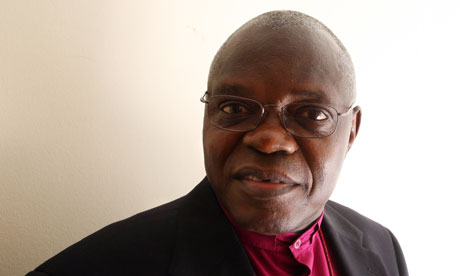
(His Grace Archbishop Dr. John Sentamu, Archbishop of York)

Nothing divides the Anglican Church like homosexuality. This is hardly news, but the genius of Anglicanism has always been that it is most opposed to intolerance, rather than letting rip with hellfire, brimstone and heaven only knows what else. So when Archbishops - as John Sentamu of York has - start lecturing politicians on gay marriage, I get worried in a hurry.

I wade into this quagmire with reticence; the challenge is that the Anglicans have been going at this issue for years, and that there is little or nothing like a debate - instead there's lots of shouting from the anti-homosexuality side, and only a little less from the pro-human rights side. 

I deplore Sentamu's comments. And I hope he is slapped down by Rowan Williams - and David Cameron - quickly. The challenge that Sentamu's reported position holds is that it makes it ok for homosexuals to be discriminated against: imagine what the outcry would have been if he had held that Christian marriage was only acceptable between whites. Sorry, universal human rights are universal - and that includes homosexual couples. Christian love is not limited in this way.


Monday, October 10, 2011

Drone Strikes: A new international norm?

(Jeff Redfern - fired a Hellfire by mistake, became a legend*)

There's much ado about drones / UAVs / RPAs at the moment, especially as Americans are engaged in an interesting debate about whether the US Government killing American citizens without apparent due process, after the killings of Anwar Al-Awlaki and Samir Kahn in Yemen in late September. Indeed, there's an interesting piece on the leaked legal advice in today's New York Times which I'll come back to in the next couple of days. For background, this Economist piece is good.

The NYT has also published an interesting article on worldwide drone proliferation, which lists the US, the UK and Israel as the three states to date which have used drones for lethal attacks (US in at least in Iraq, Afghanistan, Pakistan and Yemen; UK in Afghanistan; Israel in Gaza and Lebanon), with many more States interested in acquiring the capability. Indeed, General Atomics Aeronautical (GA-ASI) have a nice website for all you aspiring Jeff Redferns out there...

But what caught my eye was this from Dennis M. Gormley, a senior research fellow at the University of Pittsburgh who the NYT quoted as: 

"“The problem is that we’re creating an international norm” — asserting the right to strike preemptively against those we suspect of planning attacks"

An international norm? Interesting, sounds like international law. As a claim, how does it stack up?

(The Peace Palace, home of the ICJ. It's architecturally absurd, but remarkable. Do go!) 

Sources of International Law
Article 38(1) of the Statute of the International Court of Justice is widely accepted as the authoritative statement of the sources of international law. These are:
a. international conventions, whether general or particular, establishing rules expressly recognized by the contesting states;
b. international custom, as evidence of a general practice accepted as law;
c. the general principles of law recognized by civilized nations;
d. subject to the provisions of Article 59, judicial decisions and the teachings of the most highly qualified publicists of the various nations, as subsidiary means for the determination of rules of law.
Which is sufficiently broad to cover just about anything. However, "an international norm" clearly falls within the ambit of Art 38(1)(c), and if there's sufficient State Practice, then hey presto we've created international law.

So it that's the theory, what does this mean in this case?

Probably not much. At least, it shouldn't mean much, as what the US is doing with it's drone strikes should not be random acts of violence against its politico-military opponents, but as permissible and proportional uses of force under LOAC. Indeed, far from being random, legitimate uses of force under LOAC, will, as usual require:

 - a conflict nexus as either International Armed Conflict or Non-International Armed Conflict;
 - military necessity,
 - humanity,
 - proportionality and
 - the ability to distinguish between military targets and civilians.

None of this changes with the use of drones / UAVs / RPAs; the rules are the same as they always were.

(Preventative warfare? Not big, clever or legal.)

What speaks volumes is the second half of Gormley's quote:
"asserting the right to strike preemptively against those we suspect of planning attacks"

I'm not at all certain the Obama Administration has reverted to the notion of preventative warfare that Bush (43) Administration advanced (to near-universal opprobrium) in 2002 and 2006. If Gormley were to show that this was the case, then the US would again be out on their own (and not in a good way). As far the claim that drones allow for the preemptive use of force outside of armed conflict because they are drones, this is risible: drone attacks are governed by the existing legal framework.

Moreover, any suggestion that drone attacks absent a conflict nexus are governed by anything other than International Human Rights Law (IHRL), which demands the use of minimum force at all times, and only allows for the use of lethal force in the exceptional cases of a clear and immediate threat to the lives of others which cannot be stopped in any other way, is also simply wrong. Quite how an IHRL-compliant lethal use of force by a drone could be justified is an interesting mental exercise, but it would have to be a circumstance in which an individual was imminently threatening the lives of others, that there was no alternative to use force, and the drone was the only option. The challenge here is that how would you know that from a drone alone? Hard to see, but the best that can be said is that it can't be excluded that there could be (extreme) circumstances in which IHRL-compliant drone attacks could be legal, but the onus will be on the attacker to demonstrate that such an attack was legal.  

But let's be clear, there is no new law here - drone attacks are more than adequately governed by the existing use of force framework, and notions of "preventative war" were - and remains - illegal. 

* But only in Doonesbury.

Saturday, September 24, 2011

Israeli Settlements are illegal. Points? Questions?

(Israeli settlement of Migron*. Even the Israeli Supreme Court agrees this one is illegal.)

I've been asked a couple of times about whether or not the Israeli settlements built on territory occupied in the 1967 Six Day War are legal, and if not, why not - given that the Israeli Government distinguishes between legal and illegal settlements in the West Bank.

The Israeli Ministry of Foreign Affairs marshals an extensive argument on their website explaining why Article 49(6) of the Fourth Geneva Convention 1949 which forbids an occupying power from "deport[ing] or transfer[ing] parts of its own civilian population into the territory it occupies" doesn't apply in the West Bank, the Golan Heights (and formerly, Gaza). The Israeli MFA's claims that:

"The provisions of the Geneva Convention regarding forced population transfer to occupied sovereign territory cannot be viewed as prohibiting the voluntary return of individuals to the towns and villages from which they, or their ancestors, had been ousted."

This is arguably true but irrelevant. It is interesting that even the Israeli MFA makes the case that ancestors - presumably back to biblical times - present a legal basis for the appropriation of land and the construction of settlements. In legal terms this is a nonsense, and in practical terms it is hopeless - it would appear to give Italians legitimate title to most of the Mediterranean world, for instance.

The Israeli MFA goes on:

"Nor does [Article 49] prohibit the movement of individuals to land which was not under the legitimate sovereignty of any state and which is not subject to private ownership. In this regard, Israeli settlements have been established only after an exhaustive investigation process, under the supervision of the Supreme Court of Israel, designed to ensure that no communities are established on private Arab land."

There are at least two problems with these assertions. First, the Israeli MFA in asserting that the territories it occupied in 1967 were "not under the legitimate sovereignty of any state" implies that it was terra nulius. Simply put, this isn't true: in 1967 the West Bank and East Jerusalem were either under the sovereignty of Jordan, or it was illegally occupied by Jordan with rights reverting to the previous legitimate sovereign. (I assume that in this case the previous legitimate sovereign was the UN as the League of Nations mandate was handed back by Britain, though I'd have to do some more work on this.) In any event, the West Bank and the other other occupied territories were not terra nulius - because if they had been, then in 1967 the UNSC would not have passed Resolution 242 calling for the withdrawal of Israeli forces from "territories occupied in the recent conflict".

Second, the record is clear that Israel does appropriate Arab land, and has used it for building settlements
In any event, the UN Security Council made clear in 1967 that the Geneva Conventions applied to the occupied territories in Resolution 237, and in 1979 that the settlements are illegal in Resolution 446, OP1 of which reads that the Security Council

 "Determines that the policy and practices of Israel in establishing settlements in the Palestinian and other Arab territories occupied since 1967 have no legal validity and constitute a serious obstruction to achieving a comprehensive, just and lasting peace in the Middle East."

Indeed - and the situation has only deteriorated since then. 

*Migron is significant as in a major victory for Peace Now, the Israeli Supreme Court ruled in August 2011 that Migron was illegal and demanded that the Israeli government remove it by April 2012, which is the first time this has happened in the West Bank.

Wednesday, September 21, 2011

Words have meanings. And Consequences.

(UN General Assembly. Bring your own seat chair. Sit anywhere. Or something.)

Well, hasn't it been an interesting couple of days? If he's achieved nothing else, then PA President Mahmoud Abbas (Abu Mazen) has put the need for a two-state solution back at the centre of the international agenda for the first time in at least the last 12 months - indeed, with the Arab Spring, it's hard to say that even the Middle East has been focussed on Israeli - Palestinian negotiations in 2011. 

I shan't bore you with lots of links to interesting stories: I assume that if you've bothered to read these blog posts, you're probably interested enough in the subject to read a range of views and therefore you hardly need me to drive the point home. And I must stress again that this is an international law blog, rather than a politics blog... which I appreciate may be a fine line to tread, but at base it looks at the legal arguments first, and if it is to make political commentary, to do so second. 

So with that out of the way, I was shocked not by Texas Governor Rick Perry's "Likud right or wrong" speech in which Perry accused President Obama of "appeasement", or by Perry's apparent suggestion that that he wanted Jerusalem “united under Israeli rule” (in contravention to US policy and UNSCR 478 (1980)); Perry seems to be a loud-mouth dimwit, even if he is running for the US Presidency. 

Altogether more shocking is by US House of Representatives Resolution H Res 112-394 introduced on 8 September by Illinois Republican Joe Walsh (below). 

(Annexation? Sure, help yourselves!)

H Res 112-394 enjoys more than 30 co-sponsors, and resolves, 

"That the House of Representatives firmly supports Israel’s right to annex Judea and Samaria in the event that the Palestinian Authority continues to press for unilateral recognition of Palestinian statehood at the United Nations."

Supports annexation? Excuse me? And as an implict punshiment for the PA pressing for "unilateral recognition of Palestinian statehood at the United Nations"? Pardon? Really?! Really?!?  

So let's look at the legal issues. All of this, it must be recalled is in territory captured by the Israeli Defence Force in the 1967 Six Day War, and subsequently occupied. Therefore, the controlling law remains the Fourth Geneva Convention (1949) (GCIV), which is binding on all states - including Israel.
  

Annexation 
The UN Charter, in outlawing aggressive wars in Article 2(4), made the acquisition of territory through conquest illegal for the first time in human history. Since 1945, therefore, annexation has also been illegal.*

In Geneva Convention Law, GCIV Article 47 forbids the removal of the population's rights under the Geneva Conventions by "any annexation by the latter of the whole or part of the occupied territory", making annexation not just illegal under the UN Charter, but also making any attempt to implement this illegal policy a crime under Geneva Law, too.

GCIV Article 49 deals with expulsions, evacuations and population transfers in its six paragraphs. It is illegal to permanently move a populations out of their occupied territory, though there are specific rules about evacuation for protection, e.g. in the case of continuing military operations. These evacuations must be temporary, and abide by international safeguards.

(On a tangent, reading Article 49 can be slightly confusing, in that the first five deal with the protection of the population under occupation, and the sixth paragraph prohibits an occupying power from transferring their population into the conquered territory; it is a Art 49(6) that makes all Israeli settlements in the West Bank and the Golan Heights (and prior to 2005, Gaza) unambiguously illegal under international law.** This nearly led Art 49(6) to become its own article in GCIV, but in the drafting conference, it stayed where it is.) 
Annexation as a collective punishment. 
Any annexation of the West Bank would, on the basis of Israeli policy in the area of East Jerusalem that the Israeli Government claims to have annexed, (and which no-one else in the international community accepts, hence the reason that Embassies in Israel are in Tel Aviv, not Jerusalem), be deprived of significant civil and political rights. This amounts to a form of collective punishment, which GCIV Article 33 expressly prohibits, demanding that "No protected person may be punished for an offence he or she has not personally committed."

So has Joe Walsh incited war crimes?

Incite: to stir, encourage, or urge on; stimulate or prompt to action: to incite a crowd to riot (Courtesy of Dictionary.com)
 
It is clear that any Israeli annexation would be unambiguously illegal, and in (i) wrongly asserting that annexation is a "right" of the Israeli state, and (ii) to link this illegal action to an illegal collective punishment, it is arguable that Representative Walsh and his colleagues are indeed inciting such - illegal - action. The question is, would this amount to what the Geneva Convention would describe as "grave breaches"? I'm not sure, and will ask some experts.

However, if it does - and both ICTR and ICTY jurisprudence has cases on incitement - arguably Congressman Walsh and his con-sponsors should be subject to action by the US Government under its obligations laid out in Common Article I of the Geneva Conventions, which requires, "The High Contracting Parties undertake to respect and to ensure respect for the present Convention in all circumstances." 

Oops. 

Perhaps someone may want to tell the Congressman.... 


* Only the Indian annexation of the Portugese colony of Goa being broadly recognised by the international community, and with the understanding that this was in effect decolonisation. 

** In a tragic irony, the first paragraph of the Art 49(6) ICRC commentary explains the historical background, and why Art 49(6) was included in the first place:  

"This clause was adopted after some hesitation, by the XVIIth International Red Cross Conference (13). It is intended to prevent a practice adopted during the Second World War by certain Powers, which transferred portions of their own population to occupied territory for political and racial reasons or in order, as they claimed, to colonize those territories. Such transfers worsened the economic situation of the native population and endangered their separate existence as a race." 

In other words, Art 49(6) was a direct repudiation of Hitler's policy of Lebensraum settling Germans and ethnic Germans across central and eastern Europe.

Friday, May 6, 2011

Was killing Osama bin Laden legal?

(Osama bin Laden, now the subject of more conspiracy theories than Elvis.)

I write this after a delightful evening discussing this subject with some students at Bennington College, to whom and in particular to Professor Eileen Scully, I'm very grateful - it was good fun. Before we start, I should stress that this post considers only whether the US action in killing Osama bin Laden (OBL*) was legal, and not whether or not it was a good idea from a policy perspective.

To do this, we need to break the question into two elements: 

Question 1: Was it legal to kill bin Laden at all? 

Question 2: If so, was it legal to kill him in Pakistan?

Q1: Was OBL a Combatant?
The first consideration that must be satisified is whether OBL was a combatant in an armed conflict, in order to invoke the Law of Armed Conflict (LOAC). Without this nexus of conflict, the targeted killing of OBL would be illegal - murder.

(An armed attack. RIP.)

Fortunately, determining that OBL was involved in a conflict of some sort after his 1996 Declaration of War on the United States, and that 9/11 attacks is reasonably straightforward, though the kind of armed conflict is open to debate. LOAC recognises two categories of conflict, each with different definitions of combatants: International Armed Conflicts governed by the 1st Additional Protocol  to the Geneva Conventions (AP I, 1977), and Non-International Armed Conflicts governed by the 2nd Additional Protocol to the Geneva Conventions (AP II, 1977). 

Combatant Status under AP I - International Armed Conflict
War between States represents the classical form, preferably with armies of two or more competing sides fighting pitched battles, usually resulting in clear winners and losers. Under the formulation, both sides began the war holding territory, and from the 18th Century onwards, armies generally wore uniforms and had a clearly discernible chain of command. Wars of this sort still take place, of course - the initial invasion of Iraq in 2003 is a good approximation of the classical case, in which one force overwhelms and occupies another country, and imposes direct rule for a period. In this sense, it would've looked familiar to European diplomats negotiating the Peace of Westphalia in 1648

Who is a combatant in these interstate conflicts? Simply, anyone who is not in the military as defined in Article 43 of AP I. And if you're not a combatant you must initially at least be treated as a civilian, and would therefore be immune from direct attack. But being a combatant is a privileged status itself - it means that you're entitled to PoW Status, something explicitly denied to spies (AP I, Article 46) and mercenaries (AP I, Article 47).

The major attraction for lawyers is that combatants who are not prisoners, shipwrecked or otherwise hors d'combat are always specifically targetable. Any attack must meet the test of distinction, military advantage and proportionality, but this is true of all attacks: the important point is that in an international armed conflict the status of the combatant is constant for long periods of time.

Combatant Status under AP II - Non-International Armed Conflict
By contrast, the (much shorter) AP II is specific for those internal conflicts that rise above the minima of 

"internal disturbances and tensions, such as riots, isolated and sporadic acts of violence" 

described in Art 1(2) of AP II. AP II recognises that in many civil wars and rebellions, the rebels are frequently part-time combatants, and therefore AP II details in Art 13(3) that 

"Civilians shall enjoy th[is] protection ... unless and for such time as they take a direct part in hostilities."

In other words, in the limiting case, the point at which a guerilla puts down her weapon, she loses combatant status and reverts to civilian status. In doing so, she cannot be targeted and therefore cannot be legally killed. 


(An interesting book. One for a future commentary.) 

As a result, determining what constitutes direct participation in hostilities (DPH) is critical, and has resulted in a significant ICRC study published in 2009. (This study is not without controversy, but Art. 13(3) is clear enough for our purposes.)

Was OBL a combatant? Did he take a direct participant in hosilities?
It's clear that depending on the extent which OBL was involved in command and control (C2) and AQ fundraising (presumably determined by intelligence) one could make a case for that though he appears to have been holed in his Abbottabad Compound, he was involved in directing, funding and inciting attacks on western targets. Indeed, assuming that the courier network wasn't there exclusively to collect take-out pizzas, it is pretty likely that OBL had a direct role in hostilities.

If proved, this role would confirm OBL's status as a combatant in AP I, and for the period in which he was undertaking these activities, a combatant under AP II. As a result, I assess that given sufficient evidence, it could reasonably conclude that OBL was a combatant, and that irrespective of your characterisation of the type of conflict, OBL could be a legitimate target.

Naturally, once OBL became a legitimate target, any attack on him would need to meet the normal criteria of discrimination of civilians, military advantage and proportionality before it could be considered legal. And the reports that President Obama elected to send in ground forces in a much riskier attack rather than simply bombing the compound strongly suggests to me that these criteria were being very carefully weighed in the US decision-making process, and that the US elected to expose their forces to greater risk to ensure that the attack itself was proportionate, precise and legal. Good for them.

(Pakistani Foreign Minister Salman Bashir, Harrumpher-in-Chief.)

Q2: Was it legal to kill OBL in Pakistan?
With Pakistani Foreign Minister Salman Bashir, his diplomats and security leaders harrumphing that killing OBL in Pakistan 'violated Pakistani sovereignty' and was by implication illegal, it is important to assess these claims.

The first point is that there is no doubt that Pakistan's sovereignty was violated by US forces; they flew in in the middle of the night, didn't stop to have their passports stamped, engaged in a 40 minute firefight, killed a number of people, collected (ie, stole) a large amount of documents and electronic equipment, jumped into their helicopters (again, without having their passports stamped leaving Pakistan) and flew away into the night back to Afghanistan. This is a pretty major violation of Pakistani sovereignty.

But sovereignty is not absolute.

Pakistan has an obligation - in common with all other States - to ensure that its' territory is not used by non-State actors for the planning and commissioning of illegal activities, including terrorism. If it does not, there are two effects: first, under Article 8 of the International Law Commission's Draft Articles on State Responsibility, the State takes legal responsibility for these actions, and second, the State that is threatened can invoke the doctrine of "Self-Help" to remove the threat IF ALL OTHER AVENUES HAVE FAILED.**

Given that the Government of Pakistan in general - and elements of the Pakistani public sector, notably the military and the ISI spy agency in particular - have had a "complex" relationship with salafist jihadis since the 1980s (ranging from sponsorship, funding and training to full-blown conflict against them depending on the time, place and level of threat to Pakistan), it would be unsurprising if the US were to conclude that Pakistan was either unwilling or unable to confront OBL in his Abbottabad compound. Worse, given that the Pakistani security network was either incompetent or colluding with OBL, the US could not have had any confidence that simply providing a name and address would result in a successful Pakistani arrest operation. Consequently, the temporary violation of Pakistani sovereignty, whilst non-trival, was in my view justified, and that therefore the attack was legal as legitimate self-help.

Overall, then, on the narrow question of whether OBL was a legitimate target I would argue that he probably was, and that the manner in which the US conducted the operation in Pakistan was also legal.

*Yes, I know the other transliteration is Usama and therefore UBL. I prefer Osama and OBL, and it's my blog. Points? Questions? I thank you.

**Ang, this is for you. We can argue about self-help later.
Saturday, March 19, 2011

The surprising Mr. Hague


(The surprisingly radical Mr. Hague. Good.)
It’s tempting (and inevitably risky) to give into hyperbole when commentating on current international events – let alone on the concomitant international legal developments: this particular road to perdition is long, wide and well trodden. But in looking at yesterday’s UN Security Council Resolution 1973 (UNSCR 1973 (2011)), I feel a little hyperbole may for once be justified. In fact, there’s every chance that the world changed more than a little bit for the better with the passage of UNSCR 1973.
(Hopefully that’s enough hyperbole for everyone.)
Some background. 

In the words of an American lawyer friend of mine, international law simply doesn’t exist. “Where does it come from? Who enforces it?”, she asks.  Despite her cynicism, International law has several sources. First and foremost, it is created by Treaties – in other words obligations freely assumed by States – by decisions of international judicial bodies, by the UN Security Council operating as a legislature by passing binding Security Council Resolutions, arguably by UN GA Resolutions – e.g. the famous 1950 ‘Uniting for Peace Resolution’, and occasionally through eminent legal scholarship. But the most interesting route of international legal development is through the developments of customary international law.
Of these, customary international law is both the most interesting and most difficult because it is based on State Practice – and as it develops, it becomes binding on all States whether they’ve explicitly adopted it or not if it is accepted by enough States. (This is how the Universal Declaration of Human Rights – widely accepted as customary international law –applies to Saudi Arabia which explicitly rejected the UDHR in 1948.) Custom is challenging because by its nature it is continuously evolving, and because it can bind States without their consent.

The crucial developmental nexus for customary international law occurs when a State acts in a certain manner because it believes that it is legally obliged to do so even though this legal obligation doesn’t exist in Treaty Law, a UNSCR, or an international judgement. This is known as opino juris. And it is in this that the Libyan crisis has been so important in humanitarian intervention, especially in the developing Responsibility to Protect (R2P) doctrine.
British Foreign Secretary William Hague’s commentary to the UK Parliament’s Foreign Affairs Select Committee (FASC) earlier this week was fascinating. Hague explained that his legal advice allowed for a humanitarian exception to Art 2(4) and Art 2(7) in cases of systematic and sustained human rights abuses without explicit authorisation from the UN Security Council. 

 (Sir Daniel Bethlemhem QC. Thank-you very much.)
I’ve don’t recall this argument being advanced by any major power since R2P was outlined in the Conclusions to the 2005 UN World Summit. This is a major step forward – and I salute Sir Daniel Bethlehem QC, the UK Foreign Office Legal Advisor and his team, for taking this courageous but legally accurate and responsible position. Better, this position seems to be shared with France, and (extrapolating wildly) I suspect that this Anglo-Franco position that a further UNSCR was not required would have had a salutary effect on the Council as a whole - and Russia and China in particular. Though both abstained, neither had an interest in allowing R2P outside of the Council's auspices to get too far out of hand (lest it be used against their interests). The result has been that the UN Security Council has mandated the extraordinarily intrusive UNSCR 1973.
UNSCR 1973 is a remarkable document. It starts by defenestrating the legitimacy of the Gaddafi regime in Operative Paragraph 2 (OP2) noting the Security Council:
“Stresses the need to intensify efforts to find a solution to the crisis which responds to the legitimate demands of the Libyan people”
Other than calls for the end of apartheid in South Africa and denunciation of Ian Smith’s rebel regime in Rhodesia from the 1960s onwards, this is remarkably un-UN language: it explicitly states that a UN Member Sate Government (which, remember, was until recently on the UN Human Rights Council in a grotesque parody of that body’s stated mission) is not responding to the Libyan people’s legitimate demands.
Given that the UN’s position on non-intervention in the affairs of Sovereign States is enshrined in Art 2(7) and one that has been a shibboleth for oppressive regimes worldwide, this is quite remarkable. I’d like to think that the Burmese and Zimbabwean UN Missions understood the implications for their own authoritarian regimes, and wrote telegrams to explain this new and (potentially uncomfortable) point for them. 
OP4 is the meat of UNSCR 1973, authorising
“… Member States that have notified the Secretary-General, acting nationally or through regional organizations or arrangements, and acting in cooperation with the Secretary-General …”
This reflects the bias in the 2005 R2P language of the desirability of a leading role for the responsible regional grouping – in the case of Libya, both the Arab League and the Organisation of the Islamic Conference have endorsed a No Fly Zone (NFZ).  But crucially, UNSCR 1973 goes much further authorising Member States:
“… to take all necessary measures, notwithstanding paragraph 9 of resolution 1970 (2011), to protect civilians and civilian populated areas under threat of attack in the Libyan Arab Jamahiriya, including Benghazi, while excluding a foreign occupation force of any form on any part of Libyan territory …”
This is not an NFZ, which I argued last week would be a reasonably pointless gesture, as it could see allied aircraft pointlessly burning holes in the sky, impotently watching Gaddafi’s forces’ massacre of the opposition. (Which, after all, is roughly what the good Colonel and his son Saif al-Islam al-Gaddafi* have promised to do.)
Instead, UNSCR 1973 explicitly foresees the use of airpower and naval gunfire to protect civilians wherever they are in Libya. Taken at face value, this implies support to the Libyan rebels in attacking and defeating Gaddafi’s forces wherever they are in Libya, and with it the Gaddafi regime. 

 (Look, all I wanted to do was order a pizza. Is that too much to ask?)
Indeed, a narrow black-letter reading could even be used to justify limited foreign ground troops, provided that any foreign ground troops were not a “foreign occupation force of any form”. In other words, theoretically at least, the legality of deploying ground troops is about the intention and duration of their deployment, rather than an absolute bar against foreign troops at all. And this flexibility could be very useful, by, for example facilitating the deployment of liaison staff to the anti-Gaddafi forces – or even the deployment of Forward Air Controllers** to coordinate strike operations. 
In other words UNSCR 1973 is a massive step forward for R2P, giving a coalition of the willing in concert with regional groupings broad authority to protect civilians and to attack a repressive regime to do so. It should also leave the world’s remaining repressive autocracies with another early incentive to commence dialogue with whatever civil society groups they’ve failed to stamp out. One suspects that UNSCR 1973 is one precedent that they’ll be keen to forget in a hurry. Somehow I rather doubt that UNSCR 1973  will slide into obscurity so soon.
(Another F3 shot. Good!)

What is needed now is for the immediate implementation of UNSCR 1973 to save Benghazi and Tobruk, and then roll back the Gaddafi regime’s power. I only wish I was still involved*** to be able to play a small role in implementing one of the greatest humanitarian interventions in the postwar period – done successfully this will in time be seen in the same bracket as Kosovo, DR Kampuchea and East Pakistan.
And unlike these three, it will be explicitly legal.
*As an LSE graduate, I do hope that the School can find a route to strip Saif al-Islam of his LSE PhD. If he cheated, as is alleged, then so much the better.
** Or Tactical Air Control Parties (TACP) or Joint Terminal Air Controllers (JTACs) or whatever the most recent Newspeak is for Forward Air Controllers.
*** As the sign outside 111(F) Sqn Hardened Aircraft Shelters at RAF Leuchars said words to this effect (for the next few weeks) “This Squadron is held at very high readiness to project fighter power worldwide. Are you ready?” Yes! F3s from Luqa, Malta fighting for Libyan liberty would be a fitting finale for the flick-knife of death. Salve, F3.

Thursday, February 24, 2011

Am I my brother's keeper?


(No sign of Muammar. An oversight.)

Cain, Abel and Muammar Gaddafi are perhaps not the most obvious of bedfellows. But Cain's riposte to God after killing the mysterious and unexplained death of Abel (a matter that remains sub judice)* is as pertinent now as it was to biblical author: what responsibility do we carry singly and jointly for the well-being of our fellow human beings? Relatedly, how does this operate in a world in which Article 2(7) of the UN Charter restates the most ancient tenet of international law - non-interference in the internal affairs of another sovereign state? In short, are we the keepers of our Libyan sisters and brothers as they face the threat of annihilation by their own government in a (final) spasm of murderous repression? 

Let's look at the notion of non-intervention, at the doctrine of humanitarian intervention and the notion of an international "Responsibility to Protect", known as R2P in txtspk.

Non-Intervention - the international community's prime directive?
If non-intervention is a cardinal rule, then Cain is right and as long as it happens next door, it's no concern of mine: I am implacably not my brother's keeper.

Some countries argue that non-intervention is the cornerstone of the international system, and that this has been the case for centuries. This is, of course, palpably risible nonsense. Advocates of non-intervention generally mean that they are in favour of non-intervention in their affairs; it is therefore no surprise that the strongest and most persistent advocates of the non-interventionist mantra include PR China, North Korea, Saudi Arabia, Cuba, Sudan and Zimbabwe, all of which have human rights records that they would wish to protect from outside scrutiny or interference. 

It is also important to note both that history is based around countries intervening in each others' internal affairs, and that intervention spans a much wider ambit than simply the use of force - sanctions, consumer boycotts, trade agreements reflect power realities and are used by stronger states to coerce weaker ones. Try asking an Irish or Greek politician about the amount of non-intervention that they’ve had to accept in their internal affairs in the form of a financial bailout – and no shots were fired. In other words, intervention in the internal affairs of other states is the norm, and the non-interventionist language in Article 2(7) is the aberration. 

 (Do we protect them? If not you, who? If not now, when?)

Humanitarian Intervention
Back in the early 1970s the International Law Association (ILA) created a framework for humanitarian intervention** which was picked up over the next decade led by Fernando Teson, an Argentine lawyer proposed along with some American lawyers a doctrine of humanitarian intervention. As a legal proposition, humanitarian intervention proposes an exception to the ban on the use of force in Article 2(4) of the UN Charter in cases of genocide, crimes against humanity or massive human rights abuses where there is no option due to time or because the Security Council is deadlocked. 

All good. (Except that Teson and his proto-neo-conservative American chums decided that not being a democracy was a gross violation of human rights, and then used this to propound the deeply problematic notion of "pro-democratic wars"; Teson's supporters tended to find themselves on the hawkish/paranoid Republican right, some of whom went so far as to suggest a NATO invasion of central Europe to drive out the Soviet totalitarians. No prizes from your blogmaster for guessing the likely outcome of that particular policy choice if you'd tried to implement it.)

In one of those strange historical oddities,*** Teson's champions today are on the left, under the banner of solidarism. Nicholas Wheeler's "Saving Strangers" is the classic exposition of the need for a framework for where there should be an exception to the UN Charter rules on non-intervention and bars on the use of force. As Wheeler shows, the three classic Cold War interventions that could have been presented as humanitarian interventions (India in East Pakistan/Bangladeshi War of Independence, 1971; Tanzania in Uganda, 1978; Vietnam in Kampuchea, 1979) never claimed any humanitarian rationale at the time. Kosovo in 1999 is a partial example of humanitarian intervention, but some structural elements were not in accord with the ILA's 1974 blueprint. Similarly, UK/US/FR extending UNSCR 688 to (and arguably beyond) breaking point for Operation Provide Comfort with the Northern and Southern No-Fly Zones over Iraq.

(Op Northern Watch - aka heroic Jags over northern Iraq. Ahh....)

So under humanitarian intervention, you can present yourself as your sister's keeper, but you don't always get a chance to do anything about it - and if you do want to do something about it, then you need to make sure you work through the ILA check list, and crucially, you need to make explicit that it is a humanitarian intervention at the time that you do it. 

Bottom line: humanitarian intervention provides an optional route for States that want to intervene - if the world is indifferent, humanitarian intervention doctrine does not require the community of nations to do anything about massive human rights violations. Just ask Jim Hacker - he explains it far more eloquently than me; the Russians were indeed too strong...

Responsibility to Protect (R to P, R2P)
The 2005 UN World Summit outcomes document specifically recognised the need for a responsibility for collective action to stop "genocide, war crimes, ethnic cleansing and crimes against humanity" - which are all defined in the ICC Rome Statute. This is the genesis for Responsibility to Protect - a key turning point in international law. 

Paragraph 139 of the 2005 World Summit outcomes states in part:

The international community, through the United Nations, also has the responsibility to use appropriate diplomatic, humanitarian and other peaceful means, in accordance with Chapters VI and VIII of the Charter, to help protect populations from genocide, war crimes, ethnic cleansing and crimes against humanity. In this context, we are prepared to take collective action, in a timely and decisive manner, through the Security Council, in accordance with the Charter, including Chapter VII, on a case-by-case basis and in cooperation with relevant regional organizations as appropriate, should peaceful means be inadequate and national authorities manifestly fail to protect their populations from genocide, war crimes, ethnic cleansing and crimes against humanity. 

Which is a real drafting hodgepodge, betraying the lack of unanimity in the international community. The answer appears to be that there is no unilateral right of intervention, the Security Council should do the right thing but there may be a regional organisation get out clause. Or not. 

So R2P is not clear yet: NGOs are pushing for clarity and for the world to move towards a Responsibility to Protect. Let's see how we're getting on. We need to speak clearly that the international community does have responsibilities and Libyan-style repression is a crime, pure and simple.


* This is a legal blog. You get legal jokes - bear with me, some of them are even funny.
**The ILA's Third Interim Report of the Subcommittee on the International Protection of Human Rights by General International Law, New Dehli, 1974

***For example the manner in which the British Conservatives have moved from being the principal supporters of British membership of the EEC to being dominated by anti-EU forces, whereas the British left moved from visceral anti-EEC agitation based on the notion that the EEC was an anti-worker capitalist plot to being broadly in favour of the EU as a method of promoting workers' interests.

Wednesday, February 23, 2011

LOAC or IHL? Words matter!

(The ICRC Customary International Law Study - a wonderful piece of work.) 

Rant Mode: ON (You have been warned.)

Words matter. Names matter.

And that is why  is why I'm always so annoyed with the ICRC's insistence on using the term "International Humanitarian Law" (IHL) when referring to the Law of Armed Conflict (LOAC). The principal (& principled) problem is that as a term IHL is dangerously close to International Human Rights Law (IHRL), inviting comparison, conflation and breeding confusion. It is true that some eminent commentators - e.g. Professor Philippe Sands QC - have characterised the two bodies of law as twins separated at birth, raised by mutually antagonistic parents. This is fair enough as both legal cannons emanate from a well-spring of humanitarianism, designed to protect people from the arbitrary predations of States and the powerful; but they are distinct.

And distinct for a reason. Human Rights Law is universal and applies at all times; these are, after all, universal minimum guarantees. The 1948 Universal Declaration of Human Rights (UDHR) enumerates the fundamental rights of people worldwide (even if there were UN members which routinely violated the UDHR's requirements in 1948 - e.g. colonial rule, apartheid, or slavery). Numerous national, regional and international human rights instruments have been added (e.g. the International Covenant on Civil and Political Rights (ICCPR) in 1966, the Convention on the Elimination of All Forms of Discrimination against Women (CEDAW) in 1979; the African charter on Human and Peoples Rights from 1981) which together with some Courts - notably the European Court of Human Rights (ECtHR) in Strasbourg - have transformed the rights of people worldwide by enunciating them and providing redress (however patchy and imperfect.) This is a proud history and a firm foundation for building a better future.

 (The rather wonderful companion to the red book, above.)

The Law of Armed Conflict (LOAC), however, is of a fundamentally different form. First and most importantly, LOAC can by definition only apply during conflict; simply, it is legal to kill an enemy combatant in wartime when killing the same person in peacetime is called murder. Second, as lex specialis (special law relating to specific circumstances), LOAC replaces the existing law for the period in which it is applicable where the two conflict. Third, specific and different rules apply for International Armed Conflicts (IACs) and Non-International Armed Conflicts (NIACs). Finally, LOAC has large elements that predate the Treaties and exist under Customary International Law which the ICRC attempted the thankless task of pulling together it the Customary Law Study (the red book at the top of the post) - a good piece of work, being improved with the current update, and is especially rewarding when read in tandem with Chatham House's critique (the blue book). 

(Not a pizza)

Any attempt to merge the two is like comparing an apple with a pizza; they are both about rights, but their form and function is entirely different.

So when the ICRC as the guardians of the central LOAC treaty-based legislation (Geneva Conventions I - IV from 1949 and the two Additional Protocols to the Conventions from 1977) tries to broaden the scope of the Conventions by extending the scope of NIACs down from insurgencies where insurgents hold territory and operate a chain of command to civil unrest and riots*, problems are inevitable. The most obvious is that as lex specialis, applying LOAC to civil unrest would actually reduce the protection of human rights, as LOAC overrides the human rights protections.

(Libya's new-old flag: today's protesters are using a variant of the old Royalist flag from pre-1969)

Applying this notion in situations in Libya today could have the following legal effect: by replacing human rights law with LOAC, instead of treating Libyan protesters as civilians engaged in awe-inspiring demotic civic dialogue, who have, amongst other things, the right to life, liberty and security of person under UDHR Article 3, the civilians could be treated as rebel combatants and legally killed as long as there was a military advantaged gained by doing so. When Col. Gaddafi promises to "die in Libya" then it's reasonable to assume that such a legal position would remove what little restraint still exists on the use of force. As bad as things are in Libya, they could be much, much worse if the survival of the state legally allowed essentially unlimited use of force against protesters.

Thus to suggest that LOAC and IHRL are the same thing is bonkers, as it serves to reduce protections and increase the incentive for oppressive regimes to go for broke. Madness, in my humble opinion.

So, a plea for clarity. LOAC is LOAC because it covers armed conflicts - and IHRL covers peacetime. The names help remind us of this, and makes for better policy.

Rant Mode: OFF

*This is a serious and separate problem. Fortunately, Chatham House are conducting an experts' working group on the Classification of Conflict which I'm looking forward to reading in due course.