Showing posts with label UN Charter. Show all posts

Saturday, March 10, 2012

CentreForum Trident Report

(Shameless self promotion, I know... deal with it!)

Forgive my lack of posting - I've been totally consumed by getting CentreForum Trident paper finished. And now it is - you can get it here - and there's been lots of interesting media coverage. I'm deeply indebted to many people - the acknowledgements are there for a reason - but the one I most liked was from the UK communist Morning Star; only the comrades know the truth. (NB Irony Alert!) We also made the wonderful ArmsControlWonk - with thanks to Dr. Jeffrey Lewis.

Normal service will be shortly be resumed...

Monday, October 31, 2011

Palestine joins UNESCO

 
So, after Palestine's formal application for UN Membership in September, UNESCO has voted to admit Palestine as a full member today. This vote (107-14-52), with 81 positive votes required, has no direct bearing on the UN membership application, though the US threat to withhold their UNESCO assessments (22% in line with the UN assessment scales) is problematic.

More soon.

Wednesday, October 26, 2011

Meanwhile, back in Yemen....

("So which bit of 'I'm still in charge' don't you get?")

2011: what a year for the UN Security Council. First with the passage of UNSCR 1970 and UNSCR 1973, the UN - with the support of the Arab League - authorised sanctions and then the use of force in Libya. Then the stop-and-start element came in with Russia and China vetoing a draft S/2011/612  over (extremely limited) action against Syria, and the moment was less optimistic. However, with the unanimous passage of UNSCR 2014 on 21 October on Yemen, and the direct support to the Gulf Cooperation Council (GCC) initiative that OP4 describes as:

"... inclusive, orderly, and Yemeni-led process of political transition, notes the signing of the Gulf Cooperation Council initiative by some opposition parties and the General People’s Congress, calls on all parties in Yemen to commit themselves to implementation of a political settlement based upon this initiative..."

The rest of UNSCR 2014 is full of sensible stuff about pushing along an implementation of the proposed settlement with President Saleh, but I was very taken with the not-quite-Chapter VII language of PP18:

"Mindful of its primary responsibility for the maintenance of international peace and security under the Charter of the United Nations, and emphasizing the threats to regional security and stability posed by the deterioration of the situation in Yemen in the absence of a lasting political settlement,"

The UNSC etc etc...

So let's watch it. If Saleh doesn't accept the GCC proposals - which is not uncontroversial given then the GCC has included an immunity clause -  then the UNSC has said that they'll return to it. It will be very interesting to see how the next phase in Yemen develops.

Saturday, October 15, 2011

Gareth Evans on R2P: Is Syria next?

(Gareth Evans QC AO)

Back at the beginning of the Libyan revolution, I asked "Am I my brother's keeper" in reference to the Responsibility to Protect, or R2P. So it was with some annoyance that I missed the lecture by Gareth Evans, the former Australian Foreign Minister, and later head of the International Crisis Group at Chatham House's International Law Programme on 6 Oct 11. Evans has been a major proponent of R2P in recent years, and under R2P, the international community undertakes to ensure that the failures of the 1990s in Rwanda, Srebenica and Kosovo are not repeated - a position that made it into Paragraph 139 of the 2005 World Summit Conclusions. Para 139 states in part:

"The international community, through the United Nations, also has the responsibility to use appropriate diplomatic, humanitarian and other peaceful means, in accordance with Chapters VI and VIII of the Charter, to help protect populations from genocide, war crimes, ethnic cleansing and crimes against humanity. In this context, we are prepared to take collective action, in a timely and decisive manner, through the Security Council, in accordance with the Charter, including Chapter VII, on a case-by-case basis and in cooperation with relevant regional organizations as appropriate, should peaceful means be inadequate and national authorities manifestly fail to protect their populations from genocide, war crimes, ethnic cleansing and crimes against humanity."

As this blog has previous pointed out, Para 139 is a real drafting hodgepodge, betraying the lack of unanimity in the international community. Crucially, should R2P - and especially the use of force - be allowed outside the direct consent of the UNSC acting under Chapter VII's Article 42? 
The relationship between R2P and Chapter VII is critical, because at one end of the spectrum, R2P is no more than a rhetorical device, as the UNSC continues to control the use of force, even in time of humanitarian emergencies; if so, it is pointless. At the other end of the scale, R2P could be construed as bolstering (the pre-existing) right of humanitarian intervention outside of the UNSC in cases where the UNSC is unable or unwilling to act.  
(Them again....)

It is therefore with great interest that I read the transcript of Gareth Evans' 6 October speech. What's particularly striking is that Evans repeatedly ties R2P very narrowly to the UNSC rather than an expansive understanding tied to humanitarian intervention, and he then sets out a five criteria test for what he takes great care to describe as 
"... legitimacy - not the criteria of legality, that's clear; Security Council support - criteria of legitimacy"

These criteria are below; though lengthy, I think it is worth quoting Evans' five-fold test in full:

The first test is seriousness of risk. Is the threatened harm of such a kind, such a scale, as to at least prima facie justify the use of military force?
 

The second test is whether the primary purpose of the proposed military action is actually to halt or avert the threat in question, as distinct from being about oil or bananas or whatever. They can be secondary or tertiary considerations and they could be quite relevant in helping to mobilize otherwise sceptical domestic constituencies but the intention test has to be what’s the primary motivation genuinely – is it to help or avert harm?

The third test is last resort. Has every non-military option been, if not applied in practise because that can be possibly time consuming in some cases, but has it at least been explored and found wanting and unlikely to serve the purpose.
 

The fourth test is one of proportionality, of a scale, the duration, the intensity of a proposed military action and the minimum necessary to meet the threat in question.

And the final and often the toughest legitimacy test is balance of consequences. Will those at risk be better or worse off as a result of such military action being taken?
 
(Decent shooting in Bab al Azizya, with photo credit to Elham at LFJL)

In Evans' view the 2011 Libyan intervention met all five criteria, though in his view they may have gone too far in prosecuting the conflict - in that it went further than the abstaining States were probably expecting when they allowed the passage of UNSCR 1973 (it passed 10-0-5, with Brazil, China, Germany, India and Russia abstaining), which probably contributed to the Chinese and Russian vetoes of draft UNSCR S/2011/612 of 4 Oct 2011. S/2011/612 was defeated 9-2-4 (China and Russia vetoing, with Brazil, India, Lebanon and South Africa abstaining); in other words, if China and Russia had abstained, there was the bare minimum of 9 votes required for passage. 

So with the death toll in anti-Assad protests reportedly reaching 3,000, what is the position of R2P after a (very benign) draft UNSCR on Syria was vetoed by the UNSC? (And let's be very clear - the vetoed text is a million miles from authorising the use of force - and had been deliberately watered down to overcome Chinese and Russian objections, which suggests that sponsors were expecting that the concessions would be sufficient get this through, and as a result it isn't likely to do much for P5 relations on the UNSC.) 

I presumed that R2P had to add something to the existing framework, by explicitly recognising a right to intervene when circumstances on the ground demanded it. Simply, without it, R2P is meaningless, and there's no point in having it at all - so why put it in Para 139 of the 2005 World Summit text? It is this element that is so confusing (and potentially disturbing) about Gareth Evans' speech - it is when the UNSC is deadlocked, and crimes are occurring on the ground that the R2P buttress to humanitarian intervention doctrine comes into its' own, and intervention to protect the civilian population should be initiated. 

(Closer to the action than Gioia was to Libya. Beer is better, too.)

This is one that will run and run, but I'd prefer to see the UK and allied aircraft that handed Benghazi's airspace back to Libyan control yesterday moved to RAF Akrotiri, Cyprus to bring a little force to bear on the Syrian regime. Akrotiri is less than 220nm from Damascus - under 25 mins flying time. But for Evans, presumably the no-go from the UNSC would mean that R2P can't be applied - and it is this result with which I have the most trouble.

So, President Obama, Prime Minister Cameron and President Sarkozy: prove that Gareth Evans is too cautious and give R2P some legs with an NFZ over Syria - it's legal, and it woulg give the Arab Spring the opportunity to bloom in Damascus, Aleppo and Homs as well. 

Sunday, September 25, 2011

More on Israeli Settlements

(Map of the West Bank in June 2011 from B'tselem)

Further to the recent posts on the (il)legality of Israeli settlements in the occupied territories, (shown above in the latest map from B'tselem) and the threat of a US veto of a Palestinian UN membership application, I was interested in looking more closely at what current US policy is on the issue of Israeli settlements.  Israel, remember, claims that settlements themselves are legal as the Fourth Geneva Convention doesn't apply in the Occupied Territories, though it accepts that there are some settlements that are illegal under Israeli domestic law, e.g. Migron. This analysis is wrong as a matter of international law, as the Geneva Conventions have customary - and therefore binding - status on all States, a fact underscored by UNSCR 827 in 1993, itself binding on all UN Members as it was adopted under Chapter VII.


In particular, I was curious about whether US policy was as lock-step behind the current Israeli Likud administration on the question of legality? It is certainly true that America's detractors and opponents would like the rest of the world to believe that the Obama Administration is in the pocket of the Likudniks, and that therefore the US was fundamentally flawed as an interlocutor in the Middle East.

(To their detractors, puppet and puppeteer. If true, which is which?)

Digging through the record, it's clear that this isn't the case, despite the visuals. 

As long ago as 1979, the UN Security Council has held that Israeli settlements constructed on land captured by Israel in 1967 are illegal through the passage of Resolution 446 on 22 March 79. UNSCR 446 was adopted 12-0-3, with Norway, UK and USA abstaining - meaning that the US allowed passage.

On 18 Feb this year, the UNSC sat for its' 6484th meeting, and considered a draft UNSCR which was proposed by 100 states in the UNGA*. The draft UNSCR's Operational Paragraphs stated:

1. Reaffirms that the Israeli settlements established in the Palestinian Territory occupied since 1967, including East Jerusalem, are illegal and constitute a major obstacle to the achievement of a just, lasting and comprehensive peace;

2. Reiterates its demand that Israel, the occupying Power, immediately and completely ceases all settlement activities in the Occupied Palestinian Territory, including East Jerusalem, and that it fully respect all of its legal obligations in this regard;

3. Calls upon both parties to act on the basis of international law and their previous agreements and obligations, including under the Roadmap, aimed, inter alia, at improving the situation on the ground, building confidence and creating the conditions necessary for promoting the peace process;

4. Calls upon all parties to continue, in the interest of the promotion of peace and security, with their negotiations on the final status issues in the Middle East peace process according to its agreed terms of reference and within the time frame specified by the Quartet in its statement of 21 September 2010;

5. Urges in this regard the intensification of international and regional diplomatic efforts to support and invigorate the peace process towards the achievement of a comprehensive, just and lasting peace in the Middle East;

6. Decides to remain seized of the matter.

For the UN, this is strong stuff; and it was duly defeated by a US veto, 14-1-0.

So far, so normal for the US's critics who assert that the US is simply a nebbish covering up for Israel's illegal excesses.

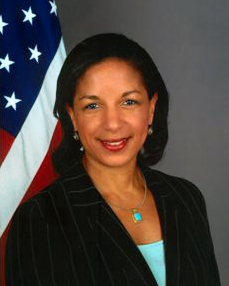
(The estimable US UN Ambassador Dr. Susan Rice).

After each Security Council vote, the UNSC members may choose to speak explaining what just happened. These speeches are known, (with a stunning lack of diplomatic originality) as "Explanation of Vote", or EOVs. Here's what Ambassador Rice had to say after the US vetoed the draft in the face of unanimity on the rest of the Security Council and against the wishes of 100 UN member states:

"The United States has been deeply committed to pursuing a comprehensive and lasting peace between Israel and the Palestinians. In that context, we have been focused on taking steps that advance the goal of two States living side by side in peace and security, rather than complicating that goal. That includes a commitment to work in good faith with all parties to underscore our opposition to continued settlements.

Our opposition to the resolution before this Council today should therefore not be misunderstood to mean we support settlement activity. On the contrary, we reject in the strongest terms the legitimacy of continued Israeli settlement activity. For more than four decades Israeli settlement activity in territories occupied in 1967 has undermined Israel’s security and corroded hopes for peace and stability in the region. Continued settlement activity violates Israel’s international commitments, devastates trust between the parties and threatens the prospects for peace.
 
The United States and our fellow Council members are also in full agreement about the urgent need to resolve the conflict between the Israel and the Palestinians on the basis of the two-State solution and an agreement that establishes a viable, independent and contiguous State of Palestine once and for all. We have invested a tremendous amount of effort and resources in pursuit of that shared goal, and we will continue to do so. But the only way to reach that common goal is through direct negotiations between the parties, with the active and sustained support of the United State and the international community. It is the Israelis’ and Palestinians’ conflict, and even the best-intentioned outsiders cannot resolve it for them."

The language is direct, and strikingly similar to that used by President Obama in threatening a veto on the Palestinian application for UN membership: if nothing else, the US was being entirely consistent. It is also heartening to hear that the US "reject[s] in the strongest terms the legitimacy of continued Israeli settlement activity", by which I presume were are suppose to understand that the US considers them illegal under international law, though they don't actually want to say so.

What is missing, of course, is successful economic or political pressure from the US to force the Israelis to freeze the settlements as a prelude to negotiations. But that is a political, not a legal matter. 

(*For the record, the co-sponsors of the draft Resolution were: Afghanistan, Algeria, Argentina, Austria, Azerbaijan, Bahrain, Bangladesh, Belarus, Belgium, the Plurinational State of Bolivia, Botswana, Brunei Darussalam, Chile, Comoros, Costa Rica, Cuba, Cyprus, the Democratic People’s Republic of Korea, Djibouti, Ecuador, Egypt, Finland, Greece, Grenada, Guatemala, Guinea, Guyana, Iceland, Indonesia, Iraq, Ireland, Israel, Jordan, Kuwait, the Lao People’s Democratic Republic, Lesotho, Liechtenstein, Luxembourg, Malaysia, Mali, Malta, Mauritania, Mauritius, Mexico, Morocco, Namibia, Nicaragua, Norway, Oman, Pakistan, Papua New Guinea, Peru, the Philippines, Qatar, Saint Vincent and the Grenadines, Saudi Arabia, Senegal, Serbia, Slovenia, Somalia, the Sudan, Sweden, Switzerland, Tajikistan, Tunisia, Turkey, Turkmenistan, the United Arab Emirates, Uruguay, the Bolivarian Republic of Venezuela, Viet Nam, Yemen and Zimbabwe.) 

Saturday, September 24, 2011

Paperwork, paperwork

(Here's one I prepared earlier.)

Here's PA President Abbas addressing the UN General Assembly, with his application in his hand. It's going to be an interesting few days.

Sunday, September 18, 2011

Palestine: the UN's 194th Member?

(PA President Mahmoud Abbas announces his application for UN Membership.
NB: The 1967 Borders includes the Old City; this includes some of the stuff in my helpful visual aide.)

Well, looks like Palestinian Authority President Mahmoud Abbas has decided to go for full UN Membership next week. Back in March, Israeli Deputy Prime Minister Ehud Barak warned that international momentum to recognise a Palestinian State on the 1967 borders constituted a "diplomatic tsunami" - and it appears to be getting ready to break in the next fortnight.

There are two issues to deal with when considering applications for UN Membership - the UN's own membership criteria and the process of obtaining membership. Paradoxically, the process is probably more important (and bizarrely, more interesting) than the criteria - which, as will be seen, can and have been fudged.

(Meanwhile, on the East River...)

So what is the process? Initially, a prospective member applies to the Secretary-General (S-G), including an instrument of willingness to accept the obligations contained within the UN Charter. The S-G then passes this across to the UNSC under Article 4(2) of the UN charter which reads:

"4.2 The admission of any such state to membership in the United Nations will be effected by a decision of the General Assembly upon the recommendation of the Security Council."

This double-action element requires the UNSC to approve and recommend membership to the UNGA, meaning that any application has to be approved by at least 9 Security Council Members, with no veto thrown by one or more of the Permanent Members. Two things are noteworthy. First, that the UNGA has never rejected a membership application recommended by the UNSC, and second, that an applicant does not become a member until the application has been approved by a two-thirds vote in the UNGA.

Admission as a political, not legal, process

As strange as it may seem to modern eyes where UN membership is assumed to be near universal - Taiwan, Palestine and Western Sahara being the obvious non-members - between 1946 and 1955 membership applications were completely constrained by the Cold War causing States to link applications together. The situation got so bad that in November 1947 the UN General Assembly asked the ICJ for an Advisory Opinion on Admission, which rejected the notion that an application could be rejected for reasons other than the criteria in Article 4(1). The UNGA went further in UNGA Resolution 197/III of December 8, 1948, in effect calling for the UNSC to give up the veto power on applications (a subject that the Security Council has given a stiff ignoring to since then).

During this period, only 9 of 31 membership applications were approved, and the Soviet Union casting 47 vetoes on membership applications in this period. (Recall, that the US didn't use the veto at all until 1972). Ironically, in light of the Obama Administration's statement that it will veto a Palestinian application for UN Membership, the 1948 US Senate Vandenburg Resolution - a key step on the road to establishing NATO - calls in Article 1 for applications to be exempt from the veto.

What criteria can apply?
Article 4(1) sets out the requirements for UN Membership. Prospective UN Members must:

          (i) be a State; 
          (ii) be peace-loving; 
          (iii) accept the obligations of the Charter;
          (iv) be able to carry out these obligations; and
          (v) be willing to do so.

(i) Is Palestine a State - 1933 Montevideo Convention
So the first question is whether Palestine is a "State"? The classical view of Statehood is the 1933 Montevideo Convention on the Rights and Duties of States, which require:

          (i) a permanent population;
          (ii) a defined territory;
          (iii) government; and
          (iv) capacity to enter into relations with the other states.

There is an interesting debate about whether the Montevideo Criteria are still applicable or whether something more amorphous reflects the current position. However, let's apply Montevideo to Palestine. In their application for UN Membership, it is reported that the Palestinian Authority (PA) will be doing so on the basis of the border of June 4, 1967 - ie, the Gaza Strip, East Jerusalem, and the West Bank occupied by Israel in the 1967 Six Day War. 

Within these boundaries, there is a permanent population, including over 500,000 Israeli settlers, whose presence is illegal under the Fourth Geneva Convention, there is a defined territory, the PA is a government of sorts - namely, it has limited powers over a delimited area - and its' writ does not run in Gaza - but is arguably a lot more effective than other UN member state governments - e.g. Somalia's Transitional Federal Government. Finally, the PA is clearly capable of entering into international relations - it has Embassies around the world, and has had UN Observer Status since 22 November 1974.

So even on the Montevideo Criteria, Palestine appears to be a State.

(Unlike Gaddafi's effort, a Green Book to revere: Justice Simma's brilliant Commentary on the UN Charter.)

(ii) Is Palestine "Peace-Loving"?
Of all of the arguments that those who oppose Palestinian UN Membership, this is superficially the most attractive - after all, hasn't there been a stream of terrorist attacks on Israel from Gaza and the West Bank? Certainly there have been some, and rocket attacks from Gaza against civilian targets inside Israel - and vice versa - should be unambiguously condemned. But as Prof. Konrad Ginther as the University of Graz notes in Simma's Commentary,

"With regard to the admission of the large number of new States resulting from decolonization, however, the criterion 'peace-loving State' was of no practical importance at all." (Ginther in Simma, Commentary, p. 182).

On this basis, the criteria is irrelevant, and we can move on. Ginther offers a more detailed explanation of the historical position: 

"More frequently, an applicant State was judged 'peace-loving' or non-'peace-loving' by reference to its current international behaviour, such as non-compliance with UN Resolutions, interference with innocent passage in territorial waters, recourse to peaceful means for the settlement of disputes, and respect for the principle of non-intervention." (Ginther in Simma, Commentary, p. 182).

Given the effort that Israel is putting into defeating a Palestinian UN membership application, it is an interesting exercise to consider whether on these criteria Israel itself could pass the requirement of being a 'peace-loving' nation.  

International good citizenship: (iii) accept the obligations of the Charter / (iv) be able to carry out these obligations / (v) be willing to do so.

It is pretty clear that the PA would comply with these five requirements - at least as well as the least effective of the UN's existing members. So I would argue that none would preclude a Palestinian membership application.  

 (President Obama speaking at Cairo University in 2009, setting out the his Administration's new approach to the Islamic World in general and the Middle East Peace Process in particular. Ah.)

Avoiding the Trainwreck
Given their public statements, it is essentially inconceivable that the Obama Administration could now back down and vote in favour of Palestinian UN membership - even though in my personal view this is the correct legal and policy choice; to do so would look ridiculous and would open the Obama Administration up to further domestic political attack that it is insufficiently supportive of Israel.*

But a veto - especially a solo veto - is far from a zero-cost option for the US. It is clear that a US veto will isolate the US internationally and in particular in the Arab and Islamic worlds, opening Obama in particular up to a reasonable charge of double standards between his support for pro-democratic forces in the Arab Spring, and the continued Israeli occupation of East Jerusalem, the West Bank and blockade of Gaza.

There is another option; the UNSC can refer an application to a Committee on Admission - a process used only once since 1952 in the case of Bangladesh in 1971/72. This provides a route for avoiding the negative fallout for the US and the region occasioned by a US veto, and buys a limited amount of time - probably up to 12 months - for real negotiations to get underway. The NY Times editorial of September 12th suggests that the Quartet (UN, US, EU, Russia) place a map on the table and essentially force both sides to negotiate the land-swaps, water rights and right of return that are at the centre of the final status agreements.  Given the circumstances, therefore, a Committee on Admission and a big-step up in the diplomatic pressure on both sides to achieve a settlement is probably the best of a number of bad options.

Conclusion

Ultimately, the niceties of international law are irrelevant if the Obama Administration has already decided to veto any resolution to allow Palestinian UN Membership. But given the above, if the US wants to veto, then they should be forced to do so alone, and the EU, and in particular Britain and France as fellow P5 members should not offer them any cover. If Palestine qualifies for Membership - and for the reasons outlined above, legally I think that it does - then let the UNSCR fail by 14-1-0 (United States).

*In fact, the Obama May 2011 speech was fair and balanced, and simply reflected the position that everyone else is working to - a two-state solution with agreed land swaps, and final status issues to be negotiated.

Monday, August 29, 2011

Another nail in the coffin

(See you in court.)

.. of Blair and Bush pretending that they ever actually intended to follow the international law when it came to Iraq. From tomorrow's Guardian, with the wonderful Philippe Sands prominent again.

I'll write more soon, I promise - been rather swamped with work.

Monday, July 4, 2011

Happy Birthday, America!


Happy July 4th to all!

But what does US Independence Day have to tell us about conceptions of Statehood? (Strange question to interrupt hot dogs, ice cream and watermelon with, I appreciate, but this is an international law blog.) Oddly, this is a more interesting question than it may at first seem.

So why July 4th? On July 2nd, 1776, the Second Continental Congress meeting in Philadelphia voted to approve a Resolution of Independence drafted by Richard Henry Lee of Virginia, and was explained in a polemic drafted by John Adams of Massachusetts, Roger Sherman of Connecticut, Robert Livingston of New York, Benjamin Franklin of Pennsylvania, and Thomas Jefferson of Virginia - the Committee of Five. Signed by John Hancock as President of the Second Continental Congress, this was approved on July 4th, and released on July 5th, and is known as the Dunlap Broadside after the printer John Dunlap and the size of paper he used - though the double entendre of a legal broadside is accurate, too.

(A different kind of broadside - USS Constitution defeats HMS Guerriere in 1812)

So what was the effect of the Declaration of Independence? At one level, it presumably demonstrated that the Continental Congress was serious in its intent to lead a revolution against British rule; but this was already underway - the Battles of Lexington and Concord had occurred in 1775. Moreover, the Revolutionary War would go on (and on, and on) until the final surrender of Cornwallis's army at Yorktown in October 1781 (though this marked what today may be called "the end of major combat operations"), with de jure independence being achieved in the 1783 Treaty of Paris, with ratification instruments exchanged in Paris on May 12, 1784. 

So, July 4th has rivals as "Independence Day". It could be the de facto independence after Cornwallis's defeat on October 19th, or the de jure independence on May 12th. 

 (Charles Cornwallis, a loser despite his immaculate tailoring)

Why does this matter?

At one level, it clearly doesn't: everyone knows that the 4th of July is US Independence Day, with parades, fireworks and family time: and a national holiday certainly isn't going to get moved to May 12th because of this blog post. But at another, it suggests that the US celebrates its' own Statehood from the Declarations of Independence - which presumably means that if a State were to meet the 1933 Montevideo Convention Criteria which enshrines the Declarative Theory's four criteria for statehood into international law, and were to declare independence, then the US would grant recognition. 

For example, this could mean that Somaliland and Palestine would be recognised by the US without further ado, and that Taiwan need only to formally declare independence to achieve US recognition. Clearly this isn't going to happen, not least as it would be far too disruptive. But it's interesting to ponder none the less. 

So, Happy 4th everyone!


Sunday, May 22, 2011

Who forgot about Abyei? Oops.

("Lucy" a canal digger abandoned in South Sudan in 1983. What a strange testament to failed development.)

Just when it looked like there may be something akin to a grown-up divorce in Sudan (think Czechoslovakia in 1993), things seem to be getting ready to go horribly wrong in Abyei.

This is a potentially a big, war-sized, problem, as though the South voted overwhelmingly for independence in January - one of the few times in history 99% of the vote probably was in favour of the proposition -  Abyei as a border community did not as neither side appears to have been able to agree on who should get to vote. (The fact that Abyei sits atop a large oil repository is obviously immaterial to either side.....)

(I still love the idea of using your cow as a flagpole. Genius!)

So, what now? With independence for South Sudan scheduled for July 9th, the international community needs to hold its nerve and get the north's troops out. And if that means the credible threat of force, then so be it. (Just don't ask the UK, please - it'd be too embarrassing not to have anything to send. Oops.)

Watch this space!

Friday, May 6, 2011

Was killing Osama bin Laden legal?

(Osama bin Laden, now the subject of more conspiracy theories than Elvis.)

I write this after a delightful evening discussing this subject with some students at Bennington College, to whom and in particular to Professor Eileen Scully, I'm very grateful - it was good fun. Before we start, I should stress that this post considers only whether the US action in killing Osama bin Laden (OBL*) was legal, and not whether or not it was a good idea from a policy perspective.

To do this, we need to break the question into two elements: 

Question 1: Was it legal to kill bin Laden at all? 

Question 2: If so, was it legal to kill him in Pakistan?

Q1: Was OBL a Combatant?
The first consideration that must be satisified is whether OBL was a combatant in an armed conflict, in order to invoke the Law of Armed Conflict (LOAC). Without this nexus of conflict, the targeted killing of OBL would be illegal - murder.

(An armed attack. RIP.)

Fortunately, determining that OBL was involved in a conflict of some sort after his 1996 Declaration of War on the United States, and that 9/11 attacks is reasonably straightforward, though the kind of armed conflict is open to debate. LOAC recognises two categories of conflict, each with different definitions of combatants: International Armed Conflicts governed by the 1st Additional Protocol  to the Geneva Conventions (AP I, 1977), and Non-International Armed Conflicts governed by the 2nd Additional Protocol to the Geneva Conventions (AP II, 1977). 

Combatant Status under AP I - International Armed Conflict
War between States represents the classical form, preferably with armies of two or more competing sides fighting pitched battles, usually resulting in clear winners and losers. Under the formulation, both sides began the war holding territory, and from the 18th Century onwards, armies generally wore uniforms and had a clearly discernible chain of command. Wars of this sort still take place, of course - the initial invasion of Iraq in 2003 is a good approximation of the classical case, in which one force overwhelms and occupies another country, and imposes direct rule for a period. In this sense, it would've looked familiar to European diplomats negotiating the Peace of Westphalia in 1648. 

Who is a combatant in these interstate conflicts? Simply, anyone who is not in the military as defined in Article 43 of AP I. And if you're not a combatant you must initially at least be treated as a civilian, and would therefore be immune from direct attack. But being a combatant is a privileged status itself - it means that you're entitled to PoW Status, something explicitly denied to spies (AP I, Article 46) and mercenaries (AP I, Article 47).

The major attraction for lawyers is that combatants who are not prisoners, shipwrecked or otherwise hors d'combat are always specifically targetable. Any attack must meet the test of distinction, military advantage and proportionality, but this is true of all attacks: the important point is that in an international armed conflict the status of the combatant is constant for long periods of time.

Combatant Status under AP II - Non-International Armed Conflict
By contrast, the (much shorter) AP II is specific for those internal conflicts that rise above the minima of 

"internal disturbances and tensions, such as riots, isolated and sporadic acts of violence" 

described in Art 1(2) of AP II. AP II recognises that in many civil wars and rebellions, the rebels are frequently part-time combatants, and therefore AP II details in Art 13(3) that 

"Civilians shall enjoy th[is] protection ... unless and for such time as they take a direct part in hostilities."

In other words, in the limiting case, the point at which a guerilla puts down her weapon, she loses combatant status and reverts to civilian status. In doing so, she cannot be targeted and therefore cannot be legally killed. 


(An interesting book. One for a future commentary.) 

As a result, determining what constitutes direct participation in hostilities (DPH) is critical, and has resulted in a significant ICRC study published in 2009. (This study is not without controversy, but Art. 13(3) is clear enough for our purposes.)

Was OBL a combatant? Did he take a direct participant in hosilities?
It's clear that depending on the extent which OBL was involved in command and control (C2) and AQ fundraising (presumably determined by intelligence) one could make a case for that though he appears to have been holed in his Abbottabad Compound, he was involved in directing, funding and inciting attacks on western targets. Indeed, assuming that the courier network wasn't there exclusively to collect take-out pizzas, it is pretty likely that OBL had a direct role in hostilities.

If proved, this role would confirm OBL's status as a combatant in AP I, and for the period in which he was undertaking these activities, a combatant under AP II. As a result, I assess that given sufficient evidence, it could reasonably conclude that OBL was a combatant, and that irrespective of your characterisation of the type of conflict, OBL could be a legitimate target.

Naturally, once OBL became a legitimate target, any attack on him would need to meet the normal criteria of discrimination of civilians, military advantage and proportionality before it could be considered legal. And the reports that President Obama elected to send in ground forces in a much riskier attack rather than simply bombing the compound strongly suggests to me that these criteria were being very carefully weighed in the US decision-making process, and that the US elected to expose their forces to greater risk to ensure that the attack itself was proportionate, precise and legal. Good for them.

(Pakistani Foreign Minister Salman Bashir, Harrumpher-in-Chief.)

Q2: Was it legal to kill OBL in Pakistan?
With Pakistani Foreign Minister Salman Bashir, his diplomats and security leaders harrumphing that killing OBL in Pakistan 'violated Pakistani sovereignty' and was by implication illegal, it is important to assess these claims.

The first point is that there is no doubt that Pakistan's sovereignty was violated by US forces; they flew in in the middle of the night, didn't stop to have their passports stamped, engaged in a 40 minute firefight, killed a number of people, collected (ie, stole) a large amount of documents and electronic equipment, jumped into their helicopters (again, without having their passports stamped leaving Pakistan) and flew away into the night back to Afghanistan. This is a pretty major violation of Pakistani sovereignty.

But sovereignty is not absolute.

Pakistan has an obligation - in common with all other States - to ensure that its' territory is not used by non-State actors for the planning and commissioning of illegal activities, including terrorism. If it does not, there are two effects: first, under Article 8 of the International Law Commission's Draft Articles on State Responsibility, the State takes legal responsibility for these actions, and second, the State that is threatened can invoke the doctrine of "Self-Help" to remove the threat IF ALL OTHER AVENUES HAVE FAILED.**

Given that the Government of Pakistan in general - and elements of the Pakistani public sector, notably the military and the ISI spy agency in particular - have had a "complex" relationship with salafist jihadis since the 1980s (ranging from sponsorship, funding and training to full-blown conflict against them depending on the time, place and level of threat to Pakistan), it would be unsurprising if the US were to conclude that Pakistan was either unwilling or unable to confront OBL in his Abbottabad compound. Worse, given that the Pakistani security network was either incompetent or colluding with OBL, the US could not have had any confidence that simply providing a name and address would result in a successful Pakistani arrest operation. Consequently, the temporary violation of Pakistani sovereignty, whilst non-trival, was in my view justified, and that therefore the attack was legal as legitimate self-help.

Overall, then, on the narrow question of whether OBL was a legitimate target I would argue that he probably was, and that the manner in which the US conducted the operation in Pakistan was also legal.

*Yes, I know the other transliteration is Usama and therefore UBL. I prefer Osama and OBL, and it's my blog. Points? Questions? I thank you.

**Ang, this is for you. We can argue about self-help later.

Thursday, March 31, 2011

Can we supply arms to the Libyan rebels?

(FGM-148 Javelin: designed to be squaddie-proof, and it is therefore probably rebel-proof.)

So the back-and-forth along the Libyan coast is continuing, and though it is encouraging that the long-serving Libyan Foreign Minister Mousa Kousa appears to have defected, it doesn't yet feel like either side is going to have a gentle stroll to victory. 

Which is why the American and British Governments are now openly discussing options for supplying the Libyan rebels despite the arms embargo. Is this legal? Secretary of State Clinton and the UK Government says yes it is. Philippe Sands QC says no it isn't. Despite my nuanced disagreement with Prof. Sands earlier this week, I'm instinctively behind him rather than the Governments.

Who's right?

 (Utterly gratuitous shot of UN Headquarters, New York. Cool though.)

The first UN Security Council Resolution is UNSCR 1970 (2011) of Feb 26, 2011. UNSCR 1970 establishes the arms embargo in Operative Paragraphs 9 - 14. Paragraph 9 states:

"9. Decides that all Member States shall immediately take the necessary measures to prevent the direct or indirect supply, sale or transfer to the Libyan Arab Jamahiriya, from or through their territories or by their nationals, or using their flag vessels or aircraft, of arms and related materiel of all types, including weapons and ammunition, military vehicles and equipment, paramilitary equipment, and spare parts for the aforementioned, and technical assistance, training, financial or other assistance, related to military activities or the provision, maintenance or use of any arms and related materiel, including the provision of armed mercenary personnel whether or not originating in their territories"

It goes on to provide some exceptions to the embargo.

This raises two questions. 

First, when UNSCR 1970 talks about banning weapons shipments to the "Libyan Arab Jamahiriya", does this mean Libya as a whole or just the Gaddafi regime? 

Second, does UNSCR 1973 (2011) generally supersede UNSCR 1970 (2011), and specifically, does the "all means necessary" language in OP4 of UNSCR 1973 mean that the arms embargo on the rebels is moot in any event? 

On the question of whether the phrase "Libyan Arab Jamahiriya" covers both sides in the conflict, I think that for two reasons it must. First, "Libyan Arab Jamahiriya" is the official name for Libya, and not that of the Gaddafi Government. More importantly, arms embargoes are typically against both sides - see, for example, the Cote d'Ivoire arms embargo in paragraph 16(c) of UNSCR 1933 (2010) - to avoid overtly taking sides. So on the first count, I think that the arms embargo must apply to both rebels and Gaddafi.  

(UNSCR 1441 adopted unanimously, Nov 8, 2002. Implied repeal meant a bad day for the hawks.)

On the second more substantive question, the doctrine of implied repeal does apply to UNSCRs: if the Security Council grants and then limits or rescinds powers - e.g. for the use of force - then States cannot rely on the earlier Resolution to do what they want. Indeed, just ask Messers Blair and Bush - this was the fundamental problem with their attempt to use UNSCRs from 1990 to legitimate their illegal 2003 attack on Iraq.

But even implied repeal only gets you so far: despite the wide latitude of UNSCR 1973 accorded to intervening States, OP4 states:

"to take all necessary measures, notwithstanding paragraph 9 of resolution 1970 (2011), to protect civilians and civilian populated areas under threat of attack in the Libyan Arab Jamahiriya"

So it directly references the arms embargo - reading, in effect;

"to take all necessary measures, notwithstanding the arms embargo, to protect civilians and civilian populated areas under threat of attack in Libya." 

This could be read as rendering the arms embargo moot if the "necessary measures" to protect civilians included the supply of arms to the rebels - or indeed, if the rebels turned nasty, to the Gaddafi forces. 

But I'm not sure. I'm yet to read the Explanation of Votes (EOVs) that accompanied UNSCR 1973 which will provide the critical colour on whether or not the Member States actually thought that they'd granted these powers to the allied coalition - the shape of which was of course unknown. 

I don't know what the definitive legal answer is: it's possible to make a case either way. 

But by far the best approach would be for the allied powers to return to the Security Council to formally vote on raising the arms embargo on the Libyan rebels. The question of whether this would survive a Russian or Chinese veto is separate, but it would in my view be a mistake to press the outer boundaries of the existing resolution out of fear of a veto by Russia or China. Faced with a choice of making them publicly defend casting a veto in favour of Gaddafi's forces, or running around like naughty school boys who know that they're stretching the rules to breaking point, let's go back to the UN and do it properly.

Thursday, March 24, 2011

Army + Air Force = Victory

 
(P-47 Thunderbolt, France, 1944 - the beginning of Air-Land Integration)

I think - and I'm sure that someone will correct me - that it was Gen. Omar Bradley who is credited with coining the phrase "Army plus Air Force* equals Victory" following the breakout from Normandy and the critical battle of Falaise Gap. This became the basis of western land doctrine at all points since then, with increasing success coming from a combination of improved communications and situational awareness, together with much more accurate air-to-ground weaponry. Thus doctrine evolved through the post-Vietnam US "Air Land Battle" doctrine - rolled out to general astonishment in Operation DESERT STORM - through to today's Air Land Integration (ALI) in Afghanistan.

But whilst this is working increasingly well in Afghanistan, it is a real challenge in Libya: fundamentally, can the anti-Gaddafi forces who are poorly equipped, and though unquestionably brave, poorly trained defeat the Libyan Army simply because of allied air power?

It's an open question. The key in ALI is integration - making sure that what you're targeting is not only the opposition, but that the targets you are hitting are being hit in the most efficient order to maximise the impact on the ground. This may mean therefore that you're hitting the tanks that you can see ahead of you on the battlefield - a tactical imperative - but that the most effective could be an attack on supply nodes, particularly on fuel, ammunition - what Colin Powell referred to in his "armchair generals worry about strategy, real generals worry about logistics" epithet in Gulf War I. It was also the basis for the 1944 "Transport Plan" in which the USAAF / RAF heavy bombers were diverted to resupply nodes in France, in order to support the ground troops by starving the German forces of supplies.

(The brilliant horseshoe. When effective, the UNSC remains our best hope for international peace and security.)

This demands a level of abstraction from the target that is harder to square with UNSCR 1973. Harder, but not impossible - OP 4 states that the mission is "to protect civilians and civilian populated areas under threat of attack in the Libyan Arab Jamahiriya" - in other words, if you can expansively interpret "threat" then a broad scale targeting plan becomes possible.

Ultimately, this broader approach is probably what will be needed if we are to avoid either stalemate in Libya, or worse, a Gaddafi victory. My hunch - and it's no more than this - is that if we can demonstrate to the line Gaddafi army units that they can defect to the rebels and live, or get destroyed in detail by allied air power, then we're several steps forward.

*Yes, I know that in 1944, the US Air Force was still part of the US Army as the US Army Air Corps.

Tuesday, March 22, 2011

Libyan Targeting

(On top of Norfolk's only hill, a Tornado GR4 armed with Storm Shadow stirs.)

I'm not involved in the targeting for the on-going operations in Libya. But all of the evidence is that those who are taking the care that I would expect, especially when it comes to so-called "collateral damage". Indeed, I was thrilled when I heard this morning that the RAF aborted a pair of Tornados when there were concerns that there were civilians in the area. It might be 1,500 miles from home, but if you're not certain, then you take the bombs 1,500 miles home again - and this is exactly what I would expect from the US forces, France and the other allies involved.

Bravo. Genuinely excellent - BZ to the crews.

But there are a three issues I wanted to deal with tonight. First, what is collateral damage? Second can we target Gaddafi personally? Third, what happens next? 

Is this legal?
Collateral Damage
It is said that the truth is the first casualty in war. This may be true, but personally, there are two other things that annoy me. Firstly, to all of the journalists out there any armoured vehicle with a gun is not necessarily "a tank". (See below). Second, lots of ill-informed nonsense about "collateral damage", ostensibly an Orwellian term for killing innocent civilians. 

So what is "collateral damage"? 

There are four kinds of damage that military action can occasion on a target. Primary Damage, Secondary Damage, Collateral Damage and War Crimes. 

Primary Damage occurs when a legitimate military target is attacked and damaged. Legitimate military targets are defined by Article 52(2) of the 1st Additional Protocol to the Geneva Conventions, 1977. Art 52(2) states:

"2. Attacks shall be limited strictly to military objectives. In so far as objects are concerned, military objectives are limited to those objects which by their nature, location, purpose or use make an effective contribution to military action and whose total or partial destruction, capture or neutralization, in the circumstances ruling at the time, offers a definite military advantage."

So the test is two-fold: not only must the target offer an "effective contribution to military action" but if the attack is successful, it must offer a " definite military advantage". I would argue that Art 52(2) is customary international law, and therefore binding on all States.  

"Secondary Damage" is the damage inflicted on a legitimate military target within the ambit of Art 52(2) caused by an attack on something else. So if you attack a weapons dump in a barracks, and the force of the blast destroys some military vehicles, it's "Secondary Damage" and legal.
  
"Collateral Damage" is damage inflicted on a civilian object (or civilian) - in the course of attacking a legitimate target under Art 52(2). So if you're attacking an ammunition dump, and as the bomb goes in, the proverbial "schoolbus full of nuns" drives by, then sadly this is "collateral damage".

The point of discrimination, though, is that if you were to aim at the "schoolbus full of nuns" then you'd be committing a war crime, the fourth type of damage.

 (Not a tank - a BMP-1 Armoured Personnel Carrier)
  
Can we target Gaddafi personally?
An interesting question. 

OP 4 of UNSCR 1973 is explicit in allowing States

"to take all necessary measures, notwithstanding paragraph 9 of resolution 1970 (2011), to protect civilians and civilian populated areas under threat of attack in the Libyan Arab Jamahiriya". 

This must include targeting that is in concert with international law, specifically Art 52(2) of AP 1, above. 

 ("My agent is holding out for Ali-G to play me in the biopic.... these negotiations are like way too stressful.")

So can we "get Gaddafi"? 

Because we don't like him? No. 

Because (to borrow a phrase) he's an "evil doer"? No, that's what the ICC referral was for.

Colonel Gaddafi and his immediate advisors (notably his sons Saif and Khamis) are exercising military command roles, and therefore if they were killed, it is likely to have a "definitive military advantage". As such, provided that they were targeted as part of the command and control apparatus, then I believe that it is legal to do so. 

(Also not a tank - an Italian Oto-Melara Palmaria 155mm self-propelled howitzer. Do keep up at the back.)

What happens next?
It's unclear. The appearance of - please note - French airpower appears to have saved Benghazi from a Gaddafi armoured column on Saturday afternoon, and the continuing attacks on the Gaddafi forces' equipment will be having an effect. But not only does UNSCR 1973 explicitly ban occupying troops, the free Libyan forces bravery is not matched by training and organisation. So expecting them to be able to take on the regular Libyan forces under Saif Gaddafi and Khamis Gaddafi is asking a lot, even with air superiority and close air support. 

(Tornado GR4 with dual-mode Brimstone)

But this picture released by the British RAF is interesting. It shows an RAF Tornado GR4 carrying dual-mode (laser and radar) guided Brimstone missiles - a UK development of the American Hellfire system, designed to kill Russian tanks near the Fulda Gap. Brimstone can be used in an autonomous mode, and is designed to kill ex-Soviet tanks. If - and this is a big if - the UK wanted to do so, it could, under UNSCR 1973, use this to attack Gaddafi armoured forces anywhere in Libya, and specifically in Tripoli. If the regime loses the ability to control Tripoli, then it will collapse much faster. 

(A tank! Finally! In this case, a former Soviet T-55.)